So a little story is in order....
We had a rather unusual awakening this morning. There we were, sleeping peacefully under our mosquito net with our heads fairly close together when suddenly our faces get doused in a mist of sorts. We obviously woke up really quick, wondering if it was raining. It has rained a few times since we moved into our bungalow and we know there aren't any leaks, so we quickly ruled that out.... Then there was some scrabbling above us in between the ceiling and the thatch roof -- it turned out to be a rat! So basically, we were woken up out of a peaceful sleep by a rat peeing on our faces..... yuck! That got us up quick. We changed our pillow cases and went swimming.
Ah the things you have to put up with when traveling. This was a new one for both of us.
Later!
-Matt!
Tuesday, July 15, 2008


Monday, July 14, 2008
The beach!
Hi all!
Sorry I haven't written in a while. Honestly, not much has happened in the last few days. =) We caught a bus from Phnon Penh down to Cambodia's "premier" beach side destination, Sihanoukville. As far as beach resort development goes, there really isn't much to speak of here yet. This town has only reemerged as a destination in the last 8 years or so, basically since the hostilities here ended. The place is ready to explode with upmarket, expensive resorts, but right now it still has the run-down feel you want in a beach get-away. The town itself isn't much to speak of, but luckily there hasn't been much reason to go there. When we first got to town four days ago, our moto driver took us to a place that was way out of town, but since it was relatively nice and we didn't know the lay of the land yet, we stayed there. This is a very common tactic for taxi, tuk-tuk, or moto drivers. Certain hotels pay commissions to have people brought to their hotels, and since travelers are often tired and disoriented from being in a new city, they end up staying at the place they were taken to. This isn't necessarily a bad thing; often these places are fairly nice (but often out of the way). We spent the first night there, then went in search of a place by the ocean. We found one, but it was more expensive and quite crappy (moldy, full of mosquitos, a loud fan, and a faucet that sprayed you in the face when you turned it on). We ended up here for a night because we'd put a deposit down on the place the day before and didn't want to lose it. First thing the next morning, we packed up our bags (again) and moved into a wonderful bungalow set up on a hillside with a fantastic view of the water from the deck. It even has a hammock! All this for $10. So finally, after three days, we feel like we're at the beach. The beach itself is a long stretch of sand lined with little eating shacks that all have beach chairs in front of them. At night these places all do BBQ, sell cheap beer, and have fire dancers that work the crowds. Pretty sweet. Our place is a little down the beach where it starts to turn into a rocky headland, so there's no sand, just beautiful sandstone rocks in the surf. This also makes our end of the beach quiet at night. All the partying takes place where the sand is. As far as I'm concerned, we have the sweetest spot on the beach.


So we've been spending our mornings reading and eating fruit and coffee on our deck, then going for lunch, then going for a swim, showering, having a snack and wine on the deck, then heading out for dinner. Pretty rough. I'll have you know that Sarah especially seems to be enjoying herself. She's really gotten into this lifestyle, if only for a few days. Our date for leaving keeps getting pushed back, but I think we'll take off in a couple more days. We've been on the road for about 6 weeks now, and both of us think it was time for a little break (a "vacation") before we continue on into Thailand. Ever since we left Beijing, we've been travelling south. We've finally reached the ocean, so now it's time to turn west and continue our trip around the globe. We'll be heading to Bangkok when we leave Sihanoukville.


I thought I'd share a couple of our observations from our time here:
There are many locals working the beach scene selling various things. The children all sell bracelets and necklaces, while the women sell fruit, manicures, pedicures (seriously) and massages. Oh, and you can get waxed if you want a hairless back, legs, or whatever. They seem to use floss or something, and a surprising number of beachgoers take them up on this (even men). Sarah's old toe nail polish attracts these women en mass. They all agree she should do something about it, but I think it looks just fine. =)
Another local subset that works the beach are men who are missing limbs. Most of them are missing a leg, and are obviously victims of one of the biggest remaining threats in Cambodia; landmines. There are still millions of landmines scattered throughout this country from decades of war, though most of them came from when the US was waging a "secret war" here in the 70's, trying to keep the Communists from spilling over from Vietnam into Cambodia. Cambodia is one of the most heavily landmined countries in the world, and over 1000 children are killed every year by these old devices. Not a legacy you'd want for your country.... Anyway, the men who beg on the beach all drag themselves around on their rears, which they have wrapped up in a cut-up inner tube to keep somewhat dry from seawater. It's a hard thing to blend "beach time" with war casualties, but that seems to be what this place does. Everyone doing what they can to make a living.
On a lighter note, one of the most common forms of clothing here seems to be pajama sets! I didn't even notice it at first, but Sarah pointed out that a large percentage of the locals (especially women) wear pajama tops and bottoms all the time. I guess it works as a matching outfit. =) It makes me feel like there are a lot of dental hygienists walking around.
Sorry I haven't written in a while. Honestly, not much has happened in the last few days. =) We caught a bus from Phnon Penh down to Cambodia's "premier" beach side destination, Sihanoukville. As far as beach resort development goes, there really isn't much to speak of here yet. This town has only reemerged as a destination in the last 8 years or so, basically since the hostilities here ended. The place is ready to explode with upmarket, expensive resorts, but right now it still has the run-down feel you want in a beach get-away. The town itself isn't much to speak of, but luckily there hasn't been much reason to go there. When we first got to town four days ago, our moto driver took us to a place that was way out of town, but since it was relatively nice and we didn't know the lay of the land yet, we stayed there. This is a very common tactic for taxi, tuk-tuk, or moto drivers. Certain hotels pay commissions to have people brought to their hotels, and since travelers are often tired and disoriented from being in a new city, they end up staying at the place they were taken to. This isn't necessarily a bad thing; often these places are fairly nice (but often out of the way). We spent the first night there, then went in search of a place by the ocean. We found one, but it was more expensive and quite crappy (moldy, full of mosquitos, a loud fan, and a faucet that sprayed you in the face when you turned it on). We ended up here for a night because we'd put a deposit down on the place the day before and didn't want to lose it. First thing the next morning, we packed up our bags (again) and moved into a wonderful bungalow set up on a hillside with a fantastic view of the water from the deck. It even has a hammock! All this for $10. So finally, after three days, we feel like we're at the beach. The beach itself is a long stretch of sand lined with little eating shacks that all have beach chairs in front of them. At night these places all do BBQ, sell cheap beer, and have fire dancers that work the crowds. Pretty sweet. Our place is a little down the beach where it starts to turn into a rocky headland, so there's no sand, just beautiful sandstone rocks in the surf. This also makes our end of the beach quiet at night. All the partying takes place where the sand is. As far as I'm concerned, we have the sweetest spot on the beach.

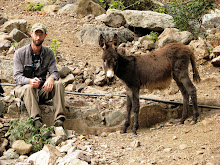
A member of the cat family that adopted us and hangs out on our deck.

Our view from our porch.

Another pic of our view over Serendipity Beach, Cambodia.

Ours is the one that spells out Eva.
So we've been spending our mornings reading and eating fruit and coffee on our deck, then going for lunch, then going for a swim, showering, having a snack and wine on the deck, then heading out for dinner. Pretty rough. I'll have you know that Sarah especially seems to be enjoying herself. She's really gotten into this lifestyle, if only for a few days. Our date for leaving keeps getting pushed back, but I think we'll take off in a couple more days. We've been on the road for about 6 weeks now, and both of us think it was time for a little break (a "vacation") before we continue on into Thailand. Ever since we left Beijing, we've been travelling south. We've finally reached the ocean, so now it's time to turn west and continue our trip around the globe. We'll be heading to Bangkok when we leave Sihanoukville.

Wine on the lanai!

More wine on the lanai (yes, I have a sunburn).

Sarah's picture of a firedancer

OK, kinda romantic....
I thought I'd share a couple of our observations from our time here:
There are many locals working the beach scene selling various things. The children all sell bracelets and necklaces, while the women sell fruit, manicures, pedicures (seriously) and massages. Oh, and you can get waxed if you want a hairless back, legs, or whatever. They seem to use floss or something, and a surprising number of beachgoers take them up on this (even men). Sarah's old toe nail polish attracts these women en mass. They all agree she should do something about it, but I think it looks just fine. =)
Another local subset that works the beach are men who are missing limbs. Most of them are missing a leg, and are obviously victims of one of the biggest remaining threats in Cambodia; landmines. There are still millions of landmines scattered throughout this country from decades of war, though most of them came from when the US was waging a "secret war" here in the 70's, trying to keep the Communists from spilling over from Vietnam into Cambodia. Cambodia is one of the most heavily landmined countries in the world, and over 1000 children are killed every year by these old devices. Not a legacy you'd want for your country.... Anyway, the men who beg on the beach all drag themselves around on their rears, which they have wrapped up in a cut-up inner tube to keep somewhat dry from seawater. It's a hard thing to blend "beach time" with war casualties, but that seems to be what this place does. Everyone doing what they can to make a living.
On a lighter note, one of the most common forms of clothing here seems to be pajama sets! I didn't even notice it at first, but Sarah pointed out that a large percentage of the locals (especially women) wear pajama tops and bottoms all the time. I guess it works as a matching outfit. =) It makes me feel like there are a lot of dental hygienists walking around.
Cambodians on vacation at the beach are amusing. This is a fairly conservative society, even at the beach, so you get a funny mix of swimmers; naked Cambodian kids, foreigners in bikinis and speedos, and (funniest of all) fully-clothed Cambodian adults. Seriously. A family will all be swimming out in the ocean, and the adults will be wearing pants and a t-shirt. Hmmm....
Love to all!
-Matt!
Love to all!
-Matt!
Wednesday, July 9, 2008
Tuk-tuk, Lady?
I mentioned tuk-tuks in a couple previous emails, but I wanted to emphasize their place in our travels again. The men who drive these carts (or motos) wait outside of every place a foreigner might go into and when you come out, they all jump up at once and yell "tuk-tuk" or "moto". They are, of course, trying to get a customer, but seeing as how Sarah and I try to walk pretty much everywhere we go around town, we usually don't take them up on this. So we endure a string of "tuk-tuk lady?" from every one of the thousands of these guys that we pass as we walk down the street. The only thing that keeps this from getting royally irritating is that it is always said with a big grin and good humor. Cambodians have a good store of both of these things. I decided I could make a lot of money selling t-shirts here that say, "NO tuk-tuk!" in really big letters. One funny side note is that we've noticed that many people selling stuff on the streets (especially children and some women) tend to use "lady" for either Sarah or I.... So I'm officially a lady!
Sarah and I arrived in Phnom Penh after a bus ride from Siem Reap. Phnom Penh is the capital of Cambodia, and a pretty decent city. The outskirts are your typical big city slums, and the traffic and pollution aren't great, but the city really has a nice feel to it. The main downtown area is situated along the banks of the Mekong River, right where the Tonle Sap River joins it. The views across the water are great, and the colonial architecture hides a lot of nice restaurants and bars (almost none of which we ate at because they are spendy). There are long, wide open areas (similar to Washington D.C.'s National Mall) in several directions, with monuments and fountains and temples all along them. They made for a great place for Sarah to run in the mornings, and in the evenings half the city was out walking, playing soccer, or sitting in the grass with their families. It was a really nice space for all of this. We stayed at a guesthouse that was teeming with guests -- seriously, we were shocked by the number of people that were in the main restaurant area at all times of the day. It made for a fun atmosphere. And we had a TV in our room!
A few nights ago (on the last night of our stay in Siem Reap) we had watched "The Killing Fields", a movie about the fall of Cambodia to the Khmer Rouge in the 1970's. It was very eerie to arrive in Phnom Penh with that movie fresh in our minds. Some of you may remember Pol Pot and his Khmer Rouge army, but for those of you who don't, let's just say he was a bad dude. We were walking down streets in Phnom Penh that would have been deserted in 1976 when the Khmer Rouge took over the city. They forced a mass evacuation of the city, and marched most of the inhabitants out into the countryside and forced them into slave labor in the rice fields. Thus began a short (3 years & 8 months), brutal reign that resulted in the deaths of almost 2 million people. I don't think even Hitler managed that. Pol Pot's goal was to create a people-run, agrarian society where people lived simply and did as they were told for the betterment of all. In reality this translated to killing every intellectual, doctor, teacher, journalist, etc, (pretty much anyone that spoke up) until everyone was equal (except the leaders, of course). There's a high school in Phnom Penh that was converted into a place of incarceration and torture -- these days it is a museum. We didn't visit this, but we did go out to the "Killing Fields" of Choeung Ek, the fields where they took everyone they interrogated at the high school. The 17,000 people who were killed here (men, women, and children) were dumped in mass graves. They apparently played loud music a lot to cover up the moans and screams so that people who lived nearby wouldn't hear them.... There's a monument erected at the sight that contains over 8000 exhumed skulls of victims, all arranged by age and sex. It's a pretty gruesome sight. You can't really see the skulls in the following photo, but they are in there. This puts a shirt I saw a few days ago into stark perspective: "Communism killed 100 million people and all I got was this lousy t-shirt".

Choeung Ek memorial, Cambodia
The killing fields themselves are quite a contradiction. Despite the terrible things that happened there, it's a beautiful place; all orchards and green fields and trees. There are birds singing, butterflies everywhere.... Very different than my visit to Dachau, a concentration camp in Germany. It was stark; iron bars, wooden shacks, bare trees, and incinerators. Choeung Ek felt like it had life again. The Cambodian people are the same way -- they've been through unspeakable horrors, but still they retain an optimism and positive outlook that is amazing. Hardy people, that's all I can say....
So to end this posting on a happier note, I included a couple pictures that Sarah took (my camera is still broken) of the interesting impromptu gas stations that we see a lot in Cambodia. In all the other countries I've ever been to, I've never encountered this. Each "gas station" is a small stand with some 2 liter glass Pepsi bottles on it. Each one is filled with gas, and when a moto bike pulls up, they pay the set price and the person dumps it in their tank! There's also a version where the station is a 55-gallon drum of gas that they pump from.

A Cambodian "gas station"

Another gas station. A driver is asleep in his tuk-tuk while other men play a game.

Selling pomelos on the streets of Phnom Penh, Cambodia.
Sarah and I arrived in Phnom Penh after a bus ride from Siem Reap. Phnom Penh is the capital of Cambodia, and a pretty decent city. The outskirts are your typical big city slums, and the traffic and pollution aren't great, but the city really has a nice feel to it. The main downtown area is situated along the banks of the Mekong River, right where the Tonle Sap River joins it. The views across the water are great, and the colonial architecture hides a lot of nice restaurants and bars (almost none of which we ate at because they are spendy). There are long, wide open areas (similar to Washington D.C.'s National Mall) in several directions, with monuments and fountains and temples all along them. They made for a great place for Sarah to run in the mornings, and in the evenings half the city was out walking, playing soccer, or sitting in the grass with their families. It was a really nice space for all of this. We stayed at a guesthouse that was teeming with guests -- seriously, we were shocked by the number of people that were in the main restaurant area at all times of the day. It made for a fun atmosphere. And we had a TV in our room!
A few nights ago (on the last night of our stay in Siem Reap) we had watched "The Killing Fields", a movie about the fall of Cambodia to the Khmer Rouge in the 1970's. It was very eerie to arrive in Phnom Penh with that movie fresh in our minds. Some of you may remember Pol Pot and his Khmer Rouge army, but for those of you who don't, let's just say he was a bad dude. We were walking down streets in Phnom Penh that would have been deserted in 1976 when the Khmer Rouge took over the city. They forced a mass evacuation of the city, and marched most of the inhabitants out into the countryside and forced them into slave labor in the rice fields. Thus began a short (3 years & 8 months), brutal reign that resulted in the deaths of almost 2 million people. I don't think even Hitler managed that. Pol Pot's goal was to create a people-run, agrarian society where people lived simply and did as they were told for the betterment of all. In reality this translated to killing every intellectual, doctor, teacher, journalist, etc, (pretty much anyone that spoke up) until everyone was equal (except the leaders, of course). There's a high school in Phnom Penh that was converted into a place of incarceration and torture -- these days it is a museum. We didn't visit this, but we did go out to the "Killing Fields" of Choeung Ek, the fields where they took everyone they interrogated at the high school. The 17,000 people who were killed here (men, women, and children) were dumped in mass graves. They apparently played loud music a lot to cover up the moans and screams so that people who lived nearby wouldn't hear them.... There's a monument erected at the sight that contains over 8000 exhumed skulls of victims, all arranged by age and sex. It's a pretty gruesome sight. You can't really see the skulls in the following photo, but they are in there. This puts a shirt I saw a few days ago into stark perspective: "Communism killed 100 million people and all I got was this lousy t-shirt".

Choeung Ek memorial, Cambodia
The killing fields themselves are quite a contradiction. Despite the terrible things that happened there, it's a beautiful place; all orchards and green fields and trees. There are birds singing, butterflies everywhere.... Very different than my visit to Dachau, a concentration camp in Germany. It was stark; iron bars, wooden shacks, bare trees, and incinerators. Choeung Ek felt like it had life again. The Cambodian people are the same way -- they've been through unspeakable horrors, but still they retain an optimism and positive outlook that is amazing. Hardy people, that's all I can say....
So to end this posting on a happier note, I included a couple pictures that Sarah took (my camera is still broken) of the interesting impromptu gas stations that we see a lot in Cambodia. In all the other countries I've ever been to, I've never encountered this. Each "gas station" is a small stand with some 2 liter glass Pepsi bottles on it. Each one is filled with gas, and when a moto bike pulls up, they pay the set price and the person dumps it in their tank! There's also a version where the station is a 55-gallon drum of gas that they pump from.

A Cambodian "gas station"

Another gas station. A driver is asleep in his tuk-tuk while other men play a game.

Selling pomelos on the streets of Phnom Penh, Cambodia.
We're on the southern coast in Sihanoukville now. Lots of beach, sun, fish, and still no birds! I'll write more soon.
Later!
-Matt!
Sunday, July 6, 2008
Angkor, Day 2
The entire next day was devoted to the temples. We hired our airport pickup guy, Sanuk, to drive us around in his tuk-tuk for the day. He'd stop at a temple and we'd get out and explore to our heart's content, then we'd hop back in and head off to the next one. It was a pretty relaxing way to cover such a large area. At each stop we'd have to run a gauntlet of women and children all persistently selling trinkets and books, which was stressful -- but at least they weren't begging. Ironically, since most of them are direct descendants of the people who built the temples, they have more of a right to be there than anyone else.


We visited many temples, including several inside the Angkor Thom complex. The first place we went to was Bayon Temple, definitely one of the more interesting ancient temples I've ever seen. The whole thing is made up of small domed hallways and lofty towers (54 of them) that feature 4 two-meter tall faces carved on each-- a face in each cardinal direction. The effect is that no matter where you are in the complex, you are watched over by at least a few of the carved heads. Creepy!

A somewhat blurry photo of a monk on some ruins, Ta Prohm Temple
Another highlight was the Terrace of the Elephants, a long, intricately carved platform from where the god-king would review his troops or have court. Across from there were a series of towers were disputes were settled. It's thought that the two opposing sides of a dispute were made to sit in their own tower until one of them died of disease or starvation. The other person was considered in the right since the guilty person would obviously get sick first. Makes sense, huh?
One of the most amazing temples was Ta Prohm. This is the temple that is featured in the movie Lara Croft -- Tomb Raider. The jungle around here has been minimally removed, so it has a much more abandoned feel than the temples that now have grass lawns all around them. Many of the biggest trees are still around, with some of them sprawling over the walls or tops of the temples. There were definitely more people wandering around here than at some of the other temples, but it was easy to see why. Very cool place.

Ta Prohm Temple, Angkor

Ta Prohm Temple, Angkor Wat

another straggler fig at Ta Prohm Temple, Angkor
The actual temple of Angkor Wat was something of a let-down after all the rest of the temples that day. Don't get me wrong, it was pretty amazing, but others beat it out for mood, setting, or stone carving. The amazing thing about it is it's size; it's supposedly the largest religious building in the world, whatever that means. It's also in really good shape -- unlike most of the other temples in the area, Angkor Wat was never truly lost or abandoned. It even managed to survive the reign of the Khmer Rouge in the 1970's.

Angkor Wat, Cambodia

Matt! and Sarah at Angkor Wat

Carvng detail at Angkor Wat
After a long, hot day at the temples, we were happy to get back to Siem Reap and find some dinner.
-Matt!
Angkor What?
As I mentioned previously, Sarah and I managed to snag 2 for 1 tickets on Lao Airlines, so we flew on down to Cambodia rather than going overland. Everything went amazingly smoothly, and we were safely in our hotel room in Siem Reap, Cambodia by 10am. For some reason we didn't have to pay the $10 airport exit tax in Vientiane, so that was a good omen. It was also great to see someone standing at the entrance to the airport here in Siem Reap holding up a card with Sarah's name on it; free pickup from the airport! Not bad for a $6/night room. We were picked up in yet another of the endless varieties taxis you find in developing nations. This one was called a remorque-moto (or simply tuk-tuk, like in Laos), and was a regular motorbike with a little covered trailer attached. It had a big comfy seat for two and the words "Lovely Jubbly" written on the back.
The first order of business when we arrived at the hotel was to take a nap, which we both did very satisfactorily for a couple hours.
The main reason to come to Siem Reap here in Cambodia is to see the world-famous ruins of Angkor Wat, a Khmer temple and one of the largest religious structures in the world. Amazingly, Angkor Wat is simply only one of the many, many, many temples and ruins scattered over a 70 square kilometer area here. Seems that each of the ancient Khmer god-kings tried to one-up their predecessors and created a whole series of massive structures, each requiring the work of thousands of people. The largest, Angkor Thom, has a 5 meter high wall that encloses 10 sq. kilometers of forest and temples. This temple was built at the height of the Khmer kingdom's power (around 800 years ago), when there were thought to be over a million people residing in the area around the royal capital.
We spent the last few hours of the first day in town at Phnom Bakheng, another massive Hindu temple built around 900 A.D. People come here for the sunsets over Tonle Sap Lake, but we found that the sunset coloring the temple itself was more amazing. This was a lucky thing too, because there were bazillions of people on top of the temple waiting for the sunset. We got down a couple levels and spent our time enjoying the carvings and sunlight in areas that were secluded and quiet. A much better way to spend the evening. I have an image in my mind from that night of a couple Buddhist monks in their saffron robes perched high up on the temple, with a rainbow in the sky behind them, a light mist coming down, and dozens of Needletails (a large type of swift) flying around. Beautiful.
More to come in the next post. Check back for pictures later, too.
-Matt!
The first order of business when we arrived at the hotel was to take a nap, which we both did very satisfactorily for a couple hours.
The main reason to come to Siem Reap here in Cambodia is to see the world-famous ruins of Angkor Wat, a Khmer temple and one of the largest religious structures in the world. Amazingly, Angkor Wat is simply only one of the many, many, many temples and ruins scattered over a 70 square kilometer area here. Seems that each of the ancient Khmer god-kings tried to one-up their predecessors and created a whole series of massive structures, each requiring the work of thousands of people. The largest, Angkor Thom, has a 5 meter high wall that encloses 10 sq. kilometers of forest and temples. This temple was built at the height of the Khmer kingdom's power (around 800 years ago), when there were thought to be over a million people residing in the area around the royal capital.
We spent the last few hours of the first day in town at Phnom Bakheng, another massive Hindu temple built around 900 A.D. People come here for the sunsets over Tonle Sap Lake, but we found that the sunset coloring the temple itself was more amazing. This was a lucky thing too, because there were bazillions of people on top of the temple waiting for the sunset. We got down a couple levels and spent our time enjoying the carvings and sunlight in areas that were secluded and quiet. A much better way to spend the evening. I have an image in my mind from that night of a couple Buddhist monks in their saffron robes perched high up on the temple, with a rainbow in the sky behind them, a light mist coming down, and dozens of Needletails (a large type of swift) flying around. Beautiful.
More to come in the next post. Check back for pictures later, too.
-Matt!
Vientiane, Laos
Hello once again!
Once we were finally able to tear ourselves away from our cute little bungalow in Vang Vieng, we hopped on another bus and headed down to Vientiane, the capitol of Laos. This capital city definitely qualifies as one of the most laid back capitals I've ever been to. With less than 300,000 people and not much traffic, it was easy to see why. The city occupies the northern bank of the Mekong River, with Thailand just across the way. There really wasn't much to see in Vientiane, but we happily spent a couple days there sampling the foods and walking the streets. One of the most exciting finds was a small grocery store that caters to the foreigners who live and work in Vientiane at the embassies, etc. We were able to find peanut butter, great coffee, and whole grain bread! Sarah was stoked about the peanut butter, but I was even happier to find corn tortilla chips! Sweet! They were "Mexican style", and made in Thailand. Another great find was the Night Market. We were able to get a fantastic meal that filled both of us up for 11,000 kip -- about $1.40. The street was lined with stalls that had large bowls of many different types of dishes, from curries to steamed greens to cricket salads. You pointed at what you wanted, and they put it in a baggie and handed it over. All the locals were walking the market and picking up all their little to go bags to take home for the family. We sat on the curb and ate using our plasticware we took from our last plane flight. As we walked home to our hotel, we couldn't help but feel a little smug that we'd eaten a fantastic meal at a fraction of the cost of the meals other travellers were eating in the trendy restaurants.... We ended up eating here two nights in a row.
Sarah had been noticing a distinct chocolate-deficiency in her diet, so we did make use of the coffee shops to find a fantastic piece of chocolate cake along with some great coffee. Oh, and air conditioning.
The main tourist sights in Vientiane were both along a nice, 4km walk. The first stop was the Arc du Triomphe, in the style of the original in France, but with a nice Buddhist twist. The Arc was constructed in 1969 with concrete donated by the United States to build an airport runway. Many locals apparently call it the "vertical runway" for this reason.
The second place we visited on the walk was the Pha That Luang, the national stupa and the symbol of both the Buddhist religion and Lao sovereignty. The original was built in the 3rd century BC to enclose a piece of Buddha's breastbone, but it has been rebuilt several times since then -- most recently by the French in 1931. See the photos to get an idea of it.
We celebrated the 4th of July by getting up early and hopping on a plane to Siem Reap, Cambodia (site of the famous Angkor Wat temples). Back in Luang Prabang we found out about 2 for 1 tickets on Lao Airlines, so we took advantage of the deal and saved ourselves two days of bus riding for not much more than the bus tickets would have cost. More on temple trekking to come!
-Matt!
Once we were finally able to tear ourselves away from our cute little bungalow in Vang Vieng, we hopped on another bus and headed down to Vientiane, the capitol of Laos. This capital city definitely qualifies as one of the most laid back capitals I've ever been to. With less than 300,000 people and not much traffic, it was easy to see why. The city occupies the northern bank of the Mekong River, with Thailand just across the way. There really wasn't much to see in Vientiane, but we happily spent a couple days there sampling the foods and walking the streets. One of the most exciting finds was a small grocery store that caters to the foreigners who live and work in Vientiane at the embassies, etc. We were able to find peanut butter, great coffee, and whole grain bread! Sarah was stoked about the peanut butter, but I was even happier to find corn tortilla chips! Sweet! They were "Mexican style", and made in Thailand. Another great find was the Night Market. We were able to get a fantastic meal that filled both of us up for 11,000 kip -- about $1.40. The street was lined with stalls that had large bowls of many different types of dishes, from curries to steamed greens to cricket salads. You pointed at what you wanted, and they put it in a baggie and handed it over. All the locals were walking the market and picking up all their little to go bags to take home for the family. We sat on the curb and ate using our plasticware we took from our last plane flight. As we walked home to our hotel, we couldn't help but feel a little smug that we'd eaten a fantastic meal at a fraction of the cost of the meals other travellers were eating in the trendy restaurants.... We ended up eating here two nights in a row.
Sarah had been noticing a distinct chocolate-deficiency in her diet, so we did make use of the coffee shops to find a fantastic piece of chocolate cake along with some great coffee. Oh, and air conditioning.
The main tourist sights in Vientiane were both along a nice, 4km walk. The first stop was the Arc du Triomphe, in the style of the original in France, but with a nice Buddhist twist. The Arc was constructed in 1969 with concrete donated by the United States to build an airport runway. Many locals apparently call it the "vertical runway" for this reason.
The second place we visited on the walk was the Pha That Luang, the national stupa and the symbol of both the Buddhist religion and Lao sovereignty. The original was built in the 3rd century BC to enclose a piece of Buddha's breastbone, but it has been rebuilt several times since then -- most recently by the French in 1931. See the photos to get an idea of it.
We celebrated the 4th of July by getting up early and hopping on a plane to Siem Reap, Cambodia (site of the famous Angkor Wat temples). Back in Luang Prabang we found out about 2 for 1 tickets on Lao Airlines, so we took advantage of the deal and saved ourselves two days of bus riding for not much more than the bus tickets would have cost. More on temple trekking to come!
-Matt!
Wednesday, July 2, 2008
Vang Vieng, Laos
We had another long bus ride from Luang Prabang to Vang Vieng. The road was consistently curvy, and the buses air shocks made for a bouncy ride through the mountains. Amazingly, only two people threw up (including the bus driver's helper). Sarah took a motion sickness tablet before we left -- a very smart thing to do, in my opinion. Later we talked to someone who had taken the double-decker "VIP" bus on the same route, and he said almost everyone on board threw up! See? Sometimes it pays not to go on the expensive bus. =)


The bungalows, Vang Vieng, Laos

Our porch, Vang Vieng, Laos
Sarah and I have mixed feelings about Vang Vieng. The surroundings are beautiful, but it's definitely on the "must-do" list for any young, party-hearty backpacker in the region. The town itself is kind of sad and dumpy. We splurged a little ($10/night) and stayed just out of town in a bungalow on the bank of the Nam Song River. The views were stunning, and our porch was the perfect place to sit and enjoy scene -- a muddy, big river flowing by and towering limestone ridges in every direction. This location made what could have been a crappy stop in a drinking town into a special couple days for us. We stayed out of town as much as possible, and enjoyed the stunning scenery outside of town; towering limestone cliffs, forest, and rice paddies. The residents of the town weren't as friendly and forthcoming as most people we've met in Laos, and from the way the backpackers who come through act, it's easy to see why. That doesn't mean they don't want to profit from them, though.
Here's the scene: Travellers come here to go "tubing" on the river, which involves renting a tube, being driven upriver a few kilometers, then floating back to town. The short trip takes at least a couple hours, because along the way there are riverside bars that throw ropes out and drag in the tubers (that's a funny name for them... tubers). After a Beerlao or two, they get back on their tubes and continue downstream to the next bar. Imagine doing this for 10 or 12 bars in a row. Now add in rope swings over the river, "happy shakes" (made with the finest marijuana and occasionally opium), and a large numbers of other tubers, and you get an idea of the scene. There were foreigners stumbling around town after their tubing that could hardly stand up. I realize this is many peoples' idea of a good time, but in a conservative, quiet society like the Lao, I can't help but think it's a little pathetic. After tubing, people go to the various restaurants around town and lie in long booths and watch endless reruns of "Friends" (literally) while they quench their post-"happy shake" munchies with food. If I was a local, I'd be a little jaded, too.
All this being said, Sarah and I had a wonderful time at our riverside get-away. We enjoyed several amazing monsoonal showers from the safety of the resort's patio and walked the back roads to several neat caves with Buddha statues in them. One area turned out to be good for birding, so I added Mustached Barbet, Black-naped Monarch, Striated Swallow, Shikra, Fork-tailed Swift, Plain Flowerpecker, etc to my list. The hills around town are riddled with caves where the local people famously hid from raiding Yunnan Chinese in the 1800's. Many of these are open to the public to visit.
Here's the scene: Travellers come here to go "tubing" on the river, which involves renting a tube, being driven upriver a few kilometers, then floating back to town. The short trip takes at least a couple hours, because along the way there are riverside bars that throw ropes out and drag in the tubers (that's a funny name for them... tubers). After a Beerlao or two, they get back on their tubes and continue downstream to the next bar. Imagine doing this for 10 or 12 bars in a row. Now add in rope swings over the river, "happy shakes" (made with the finest marijuana and occasionally opium), and a large numbers of other tubers, and you get an idea of the scene. There were foreigners stumbling around town after their tubing that could hardly stand up. I realize this is many peoples' idea of a good time, but in a conservative, quiet society like the Lao, I can't help but think it's a little pathetic. After tubing, people go to the various restaurants around town and lie in long booths and watch endless reruns of "Friends" (literally) while they quench their post-"happy shake" munchies with food. If I was a local, I'd be a little jaded, too.
All this being said, Sarah and I had a wonderful time at our riverside get-away. We enjoyed several amazing monsoonal showers from the safety of the resort's patio and walked the back roads to several neat caves with Buddha statues in them. One area turned out to be good for birding, so I added Mustached Barbet, Black-naped Monarch, Striated Swallow, Shikra, Fork-tailed Swift, Plain Flowerpecker, etc to my list. The hills around town are riddled with caves where the local people famously hid from raiding Yunnan Chinese in the 1800's. Many of these are open to the public to visit.

Bridge across the Nam Song River, Vang Vieng, Laos

A sawngthaew (I call them sag wagons) -- one of the weirdest vehicles ever

A wat in town, Vang Vieng, Laos
This morning we hopped on an early bus out of town, and are now in Vientiane, the most relaxed capital city it the world. More on this location tomorrow! I'll also try and get some photos added to these posts, as well.
-Matt!
-Matt!
Subscribe to:
Posts (Atom)